About
About Letters on Baptism
Letters on Baptism was published in 1893 by Edmund Burke Fairfield, a longtime Baptist minister, educator, and public figure who came to reconsider a doctrine he had once held with complete confidence.
The circumstances behind the book are part of what makes it worth reading.
Fairfield had been a Baptist for more than twenty-five years and believed that immersion was the only valid form of Christian baptism. When a Baptist publishing house asked him to prepare a substantial defense of the Baptist position, he accepted the assignment expecting the argument to be straightforward.
Instead, his research changed his mind.
Fairfield says he spent more than two years working through the biblical, linguistic, historical, and theological evidence while trying to preserve his former position. Eventually he concluded that he could no longer defend the claim that the New Testament word baptizo necessarily meant immersion, or that immersion was the only form of baptism permitted by Scripture.
The book that emerged from that study is unusually personal for a theological work of its kind. Fairfield was explaining to a Christian friend why he had changed his mind about something he had preached and practiced for decades. He retained the form of those letters when the work was published.
“I found tower after tower of my Baptist fort tumbling down!”
That sentence from the first letter captures much of the character of the book. Fairfield writes as someone reconsidering his own former arguments from the inside. He repeatedly expresses respect for the Baptist Christians with whom he disagrees and asks his reader to examine the evidence for himself.
What Fairfield is arguing
The central issue of the book is the mode and meaning of baptism.
Fairfield begins with the Greek word baptizo. Baptist arguments of his day commonly treated immersion as part of the word’s essential meaning. If baptizo means “immerse,” then the command to baptize would itself prescribe immersion.
Fairfield came to believe that this was mistaken.
Across fifteen letters, he works through classical Greek usage, the Septuagint, Jewish ceremonial washings, the New Testament baptism accounts, Romans 6, baptism with the Holy Spirit, and the testimony of early Christian writers.
His argument develops gradually. He contends that the biblical use of baptism language is closely connected with purification and cleansing, and that Scripture describes such purification using washing, pouring, and sprinkling. From there he argues that the New Testament does not establish immersion as the exclusive mode of Christian baptism.
The book therefore spends considerable time on passages that have long appeared in debates over baptism: John’s baptisms in the Jordan, the Ethiopian eunuch, Pentecost, the Philippian jailer, Lydia, Cornelius, Romans 6, Hebrews 9, and the language of baptism with the Holy Spirit.
Readers who want the structure of the argument before working through the complete book can use the argument overview, which follows Fairfield’s reasoning letter by letter.
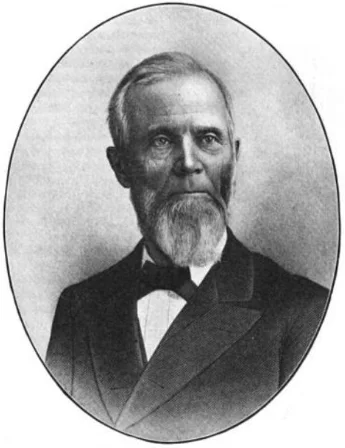
- 1821
- Born
- 1842
- Graduates from Oberlin College
- 1840s
- Pastor, Ruggles Street Baptist Church, Boston
- 1848–69
- President of Michigan Central College, now Hillsdale College
- 1857–61
- Michigan Senate, then lieutenant governor of Michigan
- 1876–82
- Chancellor of the University of Nebraska
- 1889–93
- United States consul at Lyon, France
- 1893
- Letters on Baptism published
- 1904
- Dies at Oberlin, Ohio
The author
Who was Edmund Burke Fairfield?
Edmund Burke Fairfield was born in 1821 and graduated from Oberlin College in 1842. He also studied theology at Oberlin and entered the Christian ministry, serving for a time as pastor of the Ruggles Street Baptist Church in Boston.
His career eventually extended well beyond the pulpit.
Fairfield became president of Michigan Central College in 1848 and helped lead the institution through its development into what is now Hillsdale College. He remained its president until 1869. During those years he also entered public life, serving in the Michigan Senate and later as lieutenant governor of Michigan.
In 1876 he became the second chancellor of the University of Nebraska, serving until 1882. He later returned to pastoral ministry and also served as a United States consul in Lyon, France.
By the time Letters on Baptism appeared in 1893, Fairfield had lived through decades of ministry, theological study, education, and public service. His change of position on baptism was therefore not an early theological experiment. It came after many years within the Baptist tradition and, according to Fairfield’s own account, after a prolonged effort to defend the position he already held.
He died in Oberlin, Ohio, in 1904.
How the letters came to be published
Fairfield explains in his preface that the letters began as actual correspondence with a Christian friend.
The friend had learned that Fairfield had changed both his views on baptism and his church affiliation, and asked him to explain why. Fairfield responded at length. Other friends subsequently heard the letters and encouraged him to publish them.
He revised and expanded portions of the correspondence but deliberately retained its original form.
That matters when reading the book. Fairfield is not writing a systematic theology of baptism. He is walking another Christian through the evidence that caused him to abandon a position they had once shared.
He also makes clear that he did not write the book out of hostility toward Baptists. In his preface he says that the letters were “not published in any sectarian spirit.” His stated purpose was narrower: to argue that Christians who administer baptism by pouring or sprinkling are acting consistently with Scripture.
“I could not have been an honest man, and continue to profess to believe what I did not believe.”
This digital edition
A digital transcription should remain accountable to its source.
This website presents a complete digital edition of the 1893 printing of Letters on Baptism, published in Boston and Chicago by the Congregational Sunday-School and Publishing Society.
The original volume survives in a copy held by the Library of Congress and digitized by the Internet Archive.
That scan is invaluable, but a nineteenth-century scanned book is not always pleasant to study from a browser. Searching is awkward, OCR contains errors, quotations are difficult to locate again, and moving repeatedly between passages becomes cumbersome.
This edition was built to make Fairfield’s book easier to read, search, study, cite, and verify while leaving the original text intact. The complete Preface and all fifteen letters are included, along with Fairfield’s original subject index.
How the text was prepared
The transcription was prepared from the original 1893 edition.
OCR provided a starting point, but the text has been reviewed and cleaned against the printed pages. Recognition errors, broken words at line endings, running headers, stray page numbers, and other artifacts introduced during scanning have been removed.
Fairfield’s prose itself has not been modernized.
His spelling, punctuation, capitalization, wording, quotations, and argument are preserved as they appear in the original volume. Where typography carries meaning, such as italics and small capitals, that distinction is preserved as well.
Corrections made during transcription concern the digital reproduction of the text, rather than rewriting Fairfield.
Original text and editorial material
There is an important distinction throughout the site between Fairfield’s work and material added for this edition.
The text of the Preface and fifteen letters is Fairfield’s.
Modern titles, summaries, reading times, argument outlines, Scripture indexes, explanatory material, study tools, and other navigational aids are editorial additions. They are intended to make the book easier to navigate without quietly inserting new material into the historical text.
Where editorial content appears, it is identified as such.
Checking the transcription yourself
Because the transcription should remain answerable to the printed page, the reader includes a Compare view that places the transcribed text beside images of the original 1893 pages. As you move through the book, the corresponding printed page can be viewed alongside the digital text.
Transcription
My disappointment you can imagine when I tell you that, as I prosecuted my study of the subject, I found tower after tower of my Baptist fort tumbling down! Most laboriously did I strive to repair them. Month after month for more than two years did I labor to maintain my old ground, but to no avail.
Original, page 13
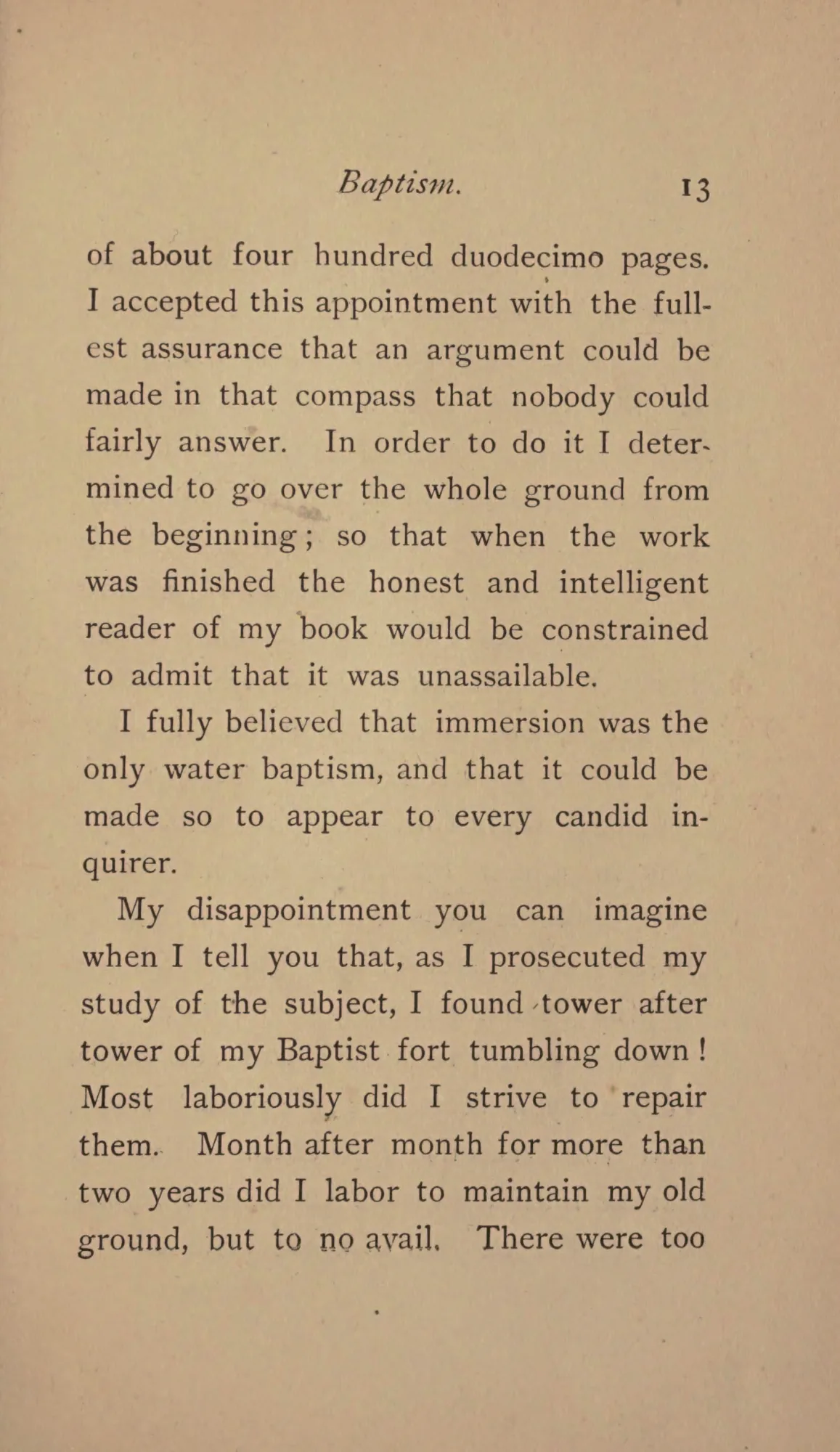
This makes it possible to check quotations, punctuation, typography, unusual readings, or transcription decisions directly against the source rather than simply trusting the edited text.
You can also view the original 1893 scan independently.
Using this edition
There are several ways to approach the book.
- In order
- To encounter the case as Fairfield’s original reader did, begin with the Preface and continue through the letters in sequence.
- Overview first
- To see where the argument is going before committing to it, read What is Fairfield arguing?, which follows his reasoning letter by letter.
- Close study
- Each letter includes study tools for following Scripture references, Greek terminology, the historical sources cited, and the progression of the argument.
- Search
- The whole book can be searched from the full-text search.
Why preserve a book like this?
The nineteenth century produced an enormous amount of theological writing that technically survives but has become practically inaccessible. A book may exist in a library archive or as a scanned PDF while remaining difficult to discover and inconvenient to study.
Letters on Baptism deserves better than that.
Whatever conclusion a reader ultimately reaches about Fairfield’s argument, the book records an unusually thorough reconsideration of a theological position by someone who had spent much of his adult life defending it. He knew the Baptist case firsthand, believed it strongly, and set out intending to strengthen it.
The result was a book explaining why he changed his mind.
This digital edition exists to make that argument available again in a form that can actually be read and studied.
Edmund B. Fairfield, D.D.
Letters on Baptism
Boston and Chicago
Congregational Sunday-School and Publishing Society
1893